Royal Foreign Government
About the Kingdom
The story of the Kissi people is one of the great untold narratives of human civilization — spanning thousands of years, crossing continents, and shaping the destiny of West Africa.
This page tells our story — from our earliest known origins to the present day. It is a story of migration and settlement, of innovation and artistry, of fierce resistance and selfless sacrifice. The Kissi are among the oldest peoples of West Africa — and among the most influential. Yet their contributions to history, to commerce, to the arts of peace and war, have too often been overlooked.
Official Seals of the Kissi Kingdom
The Kissi Kingdom employs a dual-seal authentication system across all official documents, decrees, and instruments. The Sovereign Seal certifies authenticity while the Royal Coat of Arms represents the Kingdom's heraldic identity and sovereign authority.

The Sovereign Seal
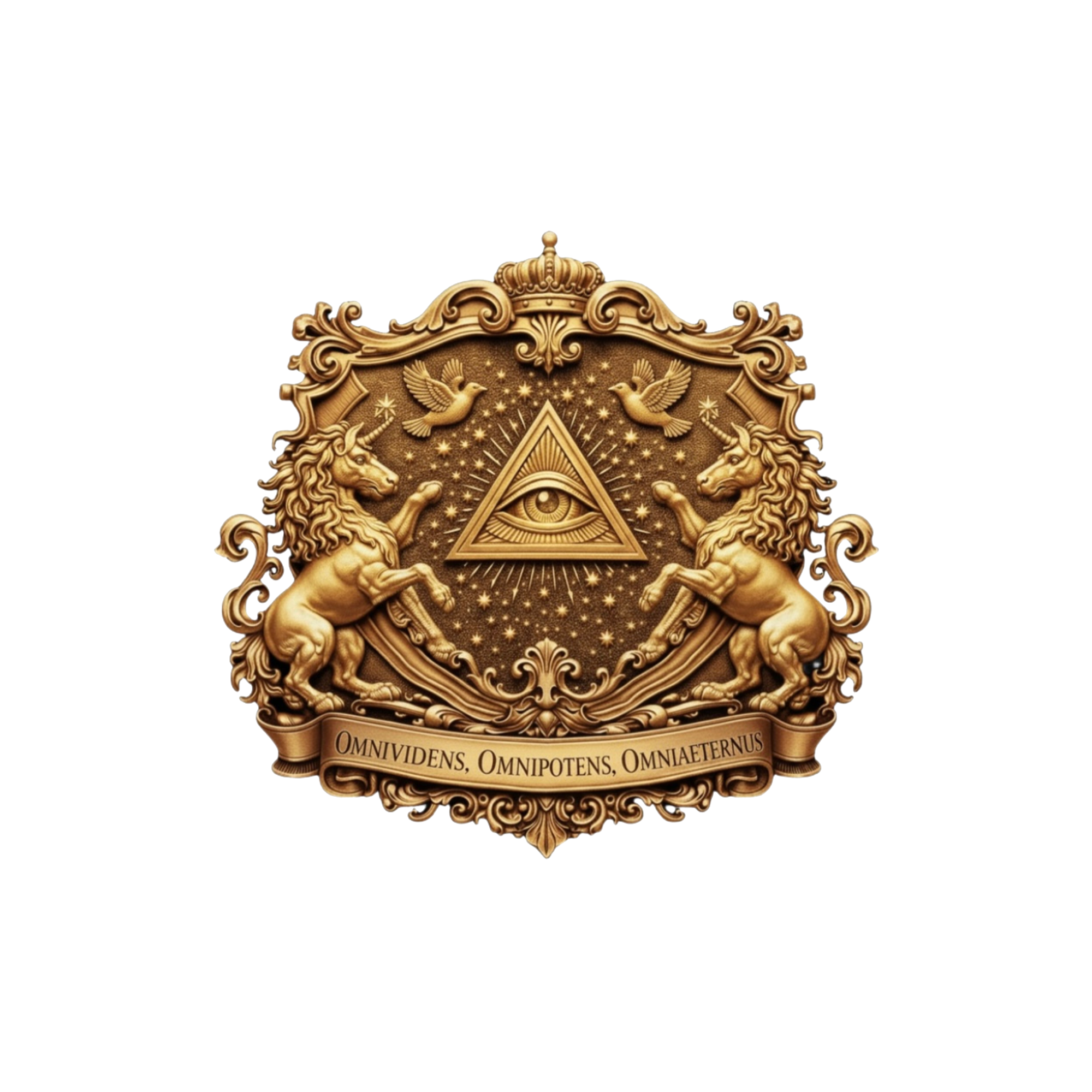
“Omnividens, Omnipotens, Omniaeternus”
The Sovereign Seal of the Kissi Kingdom bears the sacred Eye of Providence within a radiant triangle — the all-seeing eye of divine authority, symbolizing omniscience, spiritual guardianship, and the Kingdom's eternal covenant with the Creator.
Two unicorns rampant flank the seal as supporters, representing purity, nobility, and sovereign grace. Above, two doves in flight embody peace — honoring the Kissi legacy as “the Peacemakers” of West Africa. A royal crown sits atop the seal, affirming supreme sovereign authority, while celestial stars scattered across the field signify divine favor and the Kingdom's eternal destiny.
This seal appears on every official document as a watermark and in the signature section, serving as the primary authentication instrument of the sovereign government.

The Royal Coat of Arms
“Omnividens · Omnipotens · Omniaeternus”
The heraldic achievement of the Kissi Kingdom, borne by two leopards rampant wearing diamond-studded collars — guardians of the throne, representing vigilance, strength, and the fierce protection of the people.
The quartered shield displays the four pillars of the Kingdom:
- ♦ Lion Rampant — courage, royal authority, and the warrior spirit of the Kissi
- ♦ Palm Tree — peace, prosperity, and the abundance of the West African homeland
- ♦ Crossed Swords — defense, military valor, and the protection of the nation
- ♦ Diamond & Gems — wealth, natural resources, and the precious legacy of the land
A royal crown of navy velvet and gold surmounts the shield, flanked by laurel wreaths — the ancient symbol of victory and honor. This emblem appears on official correspondence, covers, and public-facing communications as the national emblem.
DUAL-SEAL ANTI-FRAUD SYSTEM
Using two distinct seals in fixed positions creates a dual-authentication system that is extremely difficult to forge. The watermark seal on every page provides tamper evidence, while the signature-section seal provides point-of-authority verification. Anyone attempting to replicate Kingdom documents would need both seals in their exact placements.
Origins: From the Ancient World to the Upper Niger
The origins of the Kissi people are deeply intertwined with the great migrations that shaped the African continent over millennia. According to the work of historians and linguists, the Kissi belong to the Mel (also called Atlantic or West Atlantic) branch of the Niger-Congo language family — one of the oldest and most widespread language families on Earth.
Scholars such as Carl Patrick Burrows have traced the ancestors of the Atlantic-group peoples — including the Kissi and the Gola — to a base in the region of ancient Mauritania, from approximately 6,000 B.C. From there, these early peoples spread southward along the West African coast through modern-day Senegal, the Gambia, and into Guinea, Sierra Leone, and Liberia.
The Kissi are believed to have been present in the region of what is now Liberia by approximately 450 B.C., making them — along with the Gola — among the very first inhabitants of the land.
Before the seventeenth century, Kissi oral tradition holds that the people inhabited the Upper Niger region, one of the great cradles of West African civilization. The Upper Niger was a crossroads of culture and commerce, connected to the legendary trading networks of the ancient Sudanic empires — Ghana, Mali, and Songhai.
The very name “Kissi” carries the echo of this ancient journey. According to folk etymology preserved in oral tradition, when the ancestors of the Kissi arrived at their homeland after a long and perilous migration, they exclaimed: “An bara kísi” — “We are saved.” From this phrase of relief and gratitude, the people took their name. They were the saved ones. The survivors. The blessed.
The Migration: Why They Left and Where They Went
The Kissi oral tradition places the origin of their migration in the Upper Niger region. They traded with the great empires to the north and built communities centered on family, faith, and the wisdom of elders.
Conflict with the Yalunka
c. 1600Around the beginning of the seventeenth century, the Kissi came into conflict with the Yalunka people of the Futa Jallon highlands. The Yalunka, who were expanding their own territory, expelled the Kissi from their lands south of the Futa Jallon. This displacement set in motion a great westward migration.
The Westward March
After their expulsion, the Kissi migrated westward in a series of movements that unfolded over generations. As they moved, they encountered and displaced the Limba people, pushing them further west. The Kissi ultimately settled in the Makona River Basin — a region of rolling hills, wooded savannas, and fertile lowlands where the borders of Guinea, Sierra Leone, and Liberia converge.
Settlement in the Makona River Basin
In Sierra Leone, the Kissi are concentrated in the Kailahun and Kono districts. In Guinea, they inhabit the regions around Guéckédou, Kissidougou, and parts of Masanta. In Liberia, they are found primarily in Foya District of Lofa County.
The city of Kissidougou in Guinea literally means “the land of the Kissi” — a testament to the people's deep and permanent connection to this region.
Connection to the Great Empires and the Keita Dynasty
The Kissi people's history is intimately connected to the great empires of West Africa. The Keita royal lineage of the Mali Empire — the dynasty of the legendary Sundiata Keita, the “Lion King” who founded the Mali Empire in the thirteenth century — is known among the Kissi as the Farmaya Keita. This lineage inhabited the canton of Farmaya in the northern reaches of Kissi country.
The greatest of the Kissi leaders, Kissi Kaba Keita, was the son of Suleimani Leno, son of Fadaka. He adopted the Mandinka name “Keita” to assert his legitimate claim to the throne, positioning himself as a descendant of the Keita dynasty through Mansa Dankaran Touman — the elder brother of Sundiata Keita himself.
This connection is not merely symbolic. It reflects a deep historical truth: that the peoples of the Upper Niger, including the Kissi, were part of the great cultural and political networks that produced some of the most powerful empires in human history.
The Mali Empire at its height controlled trade routes stretching from the Atlantic coast to the Sahara, producing legendary figures like Mansa Musa — the richest person in recorded history. The Kissi connection to this tradition speaks to the depth and significance of their royal heritage.
The Kissi and the Kida Family
Within the Kissi royal tradition, the Kida family holds a place of singular importance. The Kida lineage has been intertwined with the governance, spiritual leadership, and cultural preservation of the Kissi people for generations. The Kida name carries the weight of ancestral authority — it is a name associated with chieftaincy, wisdom, and the sacred responsibility of guiding the people.
The Kida family's connection to the Kissi people reflects the broader structure of Kissi governance: a system in which leadership is inherited through established lineages, validated by the community, and exercised with the counsel of elders. The Royal House of Kissi, under the regency of Her Royal Highness, continues this tradition — honoring the legacy of the Kida family and the broader network of Kissi royal lineages while charting a new course for the Kingdom's future.
Colonial Recognition
Recognition by France
When the French colonial administration arrived in Guinea in the 1890s, they encountered a Kissi people who were organized, formidable, and led by powerful chiefs. The French formally recognized Kissi Kaba Keita as chief of the northern Kissi territory — an acknowledgment that the Kissi were not a scattered people but a unified nation.
Recognition by the United Kingdom
On the Sierra Leonean side, the British colonial government similarly recognized Kissi chieftaincy structures. The British appointed Paramount Chiefs in Kissi-majority areas, particularly in the Kailahun District, and incorporated Kissi territory into the British Protectorate of Sierra Leone.
The Colonial Border Problem
One of the most consequential outcomes of colonialism for the Kissi was the partition of their homeland by three colonial powers. The Makona River Basin — the heart of the Kissi nation — was divided by borders drawn in European capitals, with no regard for the people who lived there.
France claimed the north (Guinea). Britain claimed the east (Sierra Leone). The Americo-Liberian settlers claimed the west (Liberia). Overnight, the Kissi people found themselves citizens of three different countries — separated by arbitrary lines on a map.
Despite this partition, the Kissi people maintained their cultural unity across all three borders. They continued to speak the same language, observe the same traditions, marry across borders, and regard themselves as one people. This resilience is a testament to the strength of Kissi identity.
The Kissi Value for Women

The Kissi people have a profound and enduring respect for women that is woven into the very fabric of their culture. In Kissi society, women are not merely participants in community life — they are its foundation.
Women share equally in agricultural work, maintain gardens, trade in local markets, raise livestock, and serve as primary caregivers and educators. But their role extends far beyond labor — women are the keepers of tradition, the guardians of spiritual life, and the conscience of the community.
Kumba Yuku — The Woman Who Gave Peace to a Continent
According to oral tradition, a time came when the great tribes of the region were locked in devastating warfare. A young Kissi woman named Kumba Yuku stepped forward with extraordinary courage and brought the conflict to an end through her selfless devotion to peace.
From that day forward, every Kissi man would be called “Uncle” and every Kissi woman “Auntie” — a sacred title of honor still observed across West Africa today.
Key Historical Leaders
| Leader | Period | Legacy |
|---|---|---|
| Kissi Kaba Keita | 1860s–1893 | Greatest Kissi warrior-king. United chiefdoms, resisted French conquest |
| Kai Londo | 1845–1885 | Warrior-administrator. Conquered territories, built roads, ruled Luawa |
| Kafura | Late 1890s–1910s | Rebel chief who maintained armed resistance for over a decade |
| Claude Kory Kondiano | Modern Era | Speaker of the National Assembly of Guinea, 2014–2020 |
| Kumba Yuku | Antiquity | Legendary Kissi matriarch who brokered peace across warring nations |